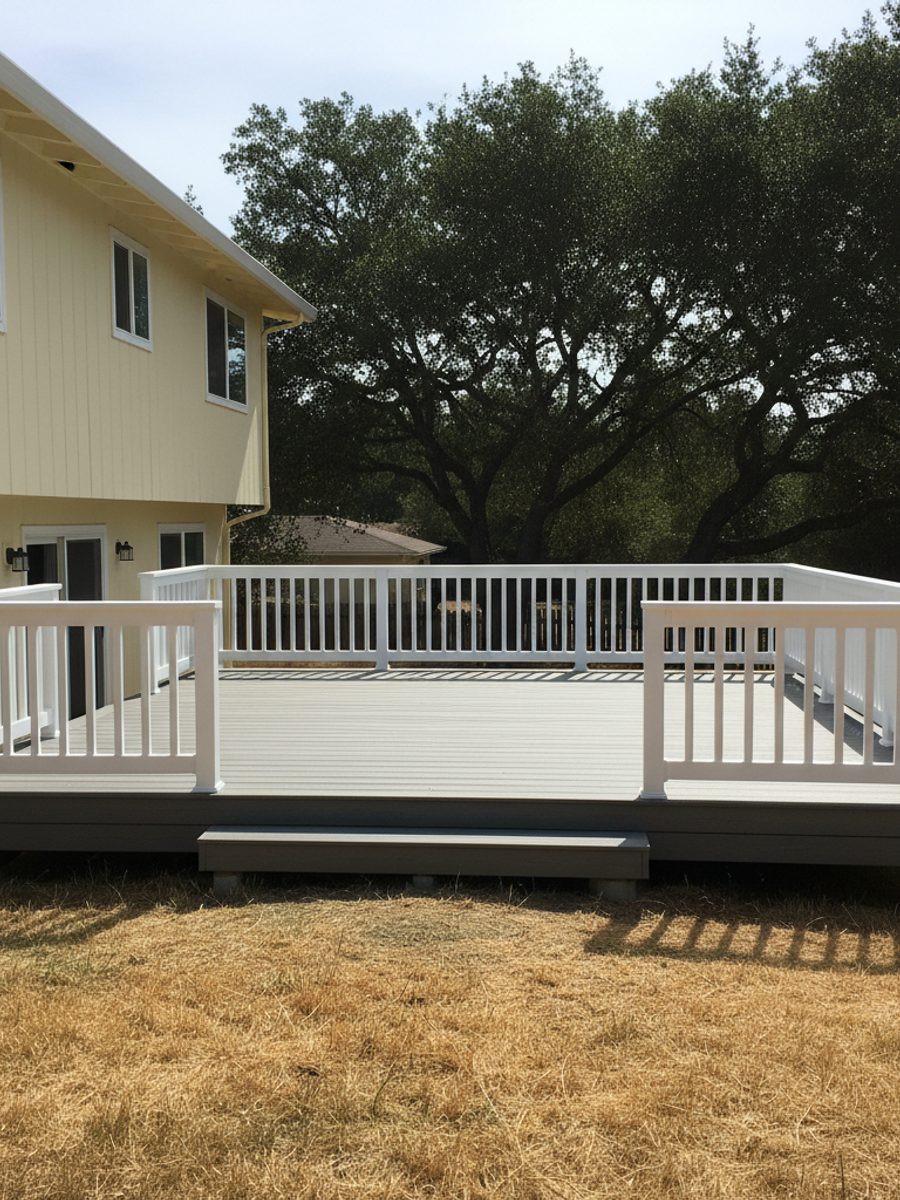
A deck doesn't fail on a schedule. It fails where water sits, where wood touches metal that's corroding, and where a board was never quite rated for the load someone put on it. In Madera's climate, decks bake all summer at 100-plus degrees and then take on moisture during the winter rains, and that swing between bone-dry and soaked is what breaks fasteners loose and cups boards. The question isn't really \"is it fall or spring,\" it's \"what's actually happening under my feet.\"
Start with the bounce test
Stand in the middle of the deck and walk it slowly, then jump once, gently, near the center of a span. A little give is normal, wood flexes. What's not normal is a spring-back feeling, a creak that sounds like it's coming from underneath rather than from the boards themselves, or any visible movement at the ledger where the deck meets the house. If you feel that, don't wait for a contractor to tell you it's fine. Get under the deck with a flashlight before you use it again.
While you're down there, take a flathead screwdriver or an awl and press it into the ledger board, the rim joists, and any post that sits near a sprinkler head or a downspout. Sound wood resists the point. Wood that's gone soft with rot lets the tool sink in with almost no pressure, and if you can push it in more than a quarter inch, that member is compromised, not just weathered.
The ledger board is the one that actually matters most
Most attached decks in this area are hung off a ledger board bolted to the house rim joist, and that single board is carrying a big share of the deck's total load. It's also the piece most likely to be flashed wrong, because flashing behind a ledger is easy to skip or skimp on during original construction. Water gets behind the siding, runs down between the ledger and the house, and rots both pieces from the inside where you can't see it until the deck starts to pull away.
Look for a gap between the ledger and the siding, dark staining, or bolt heads that look rusted or loose. A ledger separating from the house by even half an inch is not a cosmetic issue. That's the connection keeping one whole edge of your deck attached to the building, and it's the single most common cause of deck collapse we see reported nationally, almost always tied back to a bad or missing flashing detail.
What's going on below the deck you don't look at
Posts that sit directly in concrete, or worse, buried straight in dirt, wick up moisture through the end grain even when the post looks fine at eye level. Pull back any soil or mulch that's built up against a post base and check the wood right at grade. That's almost always the first place rot starts, not at the top of the post where the sun and air can reach it.
Joist hangers are galvanized steel, and if your deck was built with older ACQ-treated lumber, the copper in that treatment reacts with plain galvanized fasteners over years and eats through them faster than people expect. Rust streaks bleeding down from a hanger, or a hanger nail that's backed out and is just sitting loose in its hole, both mean the connection isn't doing its job anymore. This kind of failure doesn't show up from the top of the deck at all. It only shows up if you actually get underneath and look.
Railings: when wobble means something
Code generally calls for a guardrail to resist 200 pounds of lateral force at any point along the top rail, and that number exists because people lean, sit, and get shoved against railings without thinking about it. If you can rock a railing post more than an inch or two at the top with hand pressure, it's not meeting that number anymore, whatever it was rated for when it was installed.
The usual cause is a post that was only ever face-mounted with lag bolts into the rim joist rather than bolted through with a structural connector, or blocking underneath that's rotted out. Either way, this is a repair to schedule now, not next spring, because railing failure is the deck problem most likely to actually hurt someone.
What can honestly wait
Not everything on a deck is urgent. Gray, weathered wood that's structurally sound is a staining and sealing job, not a repair, and it can wait for a stretch of dry weather that suits your schedule rather than the calendar. A few individual boards that have cupped or split from sun exposure can be swapped out one at a time without touching the frame underneath. Surface splinters, faded color, and small gaps between boards that have shrunk slightly are cosmetic. They'll affect how the deck looks and feels underfoot before they affect whether it holds you up.
The way to tell the difference: cosmetic problems are on top, where the sun and foot traffic reach. Structural problems are underneath, at connections, or where wood meets something wet. If you're only ever looking at the decking boards from above, you're checking the part of the deck least likely to actually fail.
A rough timeline, since people always ask
A well-built deck with proper flashing and stainless or coated fasteners can go 15 to 20 years before it needs structural work, with staining every 2 to 3 years to keep water off the wood in the meantime. A deck built without flashing behind the ledger, or with the original 1990s-era hardware, is often showing real problems by year 10 to 12. Composite decking changes the surface-level math since the boards themselves don't rot, but the framing underneath is still almost always wood, and it still needs the same inspection.
If you've done the bounce test, the screwdriver test, and a look under the deck at the ledger and posts and something felt wrong, that's not a wait-and-see situation. We handle framing and structural repair, ledger and flashing fixes, railing replacement, and full rebuilds when a deck's past the point of patching, and we'll tell you straight if what you've got is a repair job or a tear-down. You can see the range of what we do at Midway Deck Co.
Need this doing? Midway Deck Co takes on deck builder jobs around Madera, CA.